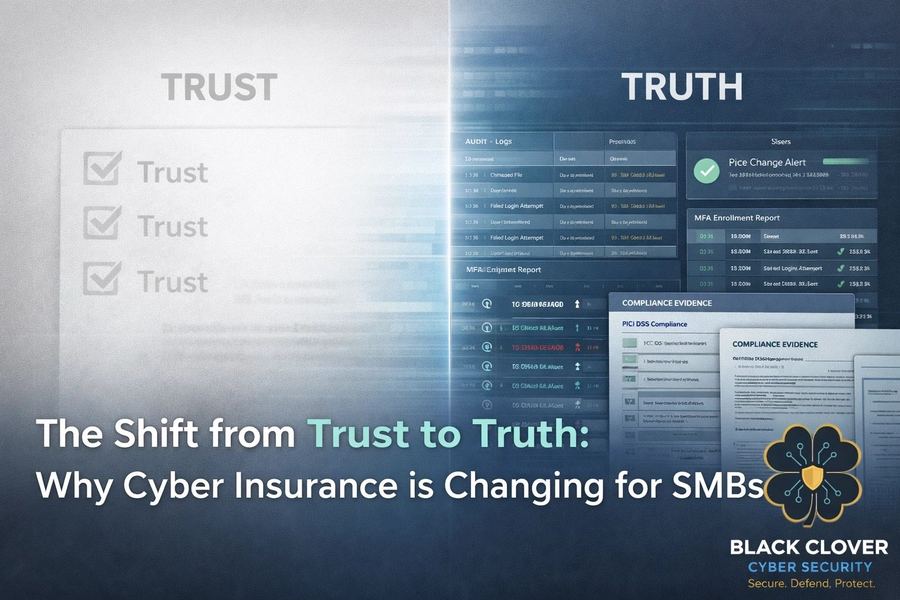
The Death of the Honor System (Part 1 of 3 in the series "The Shift from Trust to Truth: Why Cyber Insurance Is Changing for SMBs")
Remember when getting cyber insurance meant filling out a questionnaire, checking a few boxes, and calling it a day? Those days are over.
For years, cyber insurance operated on something close to an honor system. Insurers asked questions like "Do you use multi-factor authentication?" and businesses answered "yes" or "no." Maybe you had MFA deployed somewhere. Maybe your IT provider mentioned they were working on it. Either way, you checked the box, signed the application, and got your policy.
That approach worked when cyber claims were relatively rare and payouts were manageable. But the landscape has shifted dramatically, and insurers have learned some expensive lessons. Now they're changing the rules.
The Old Way Just Stopped Working
Here's what happened: insurers got burned. Repeatedly.
When ransomware attacks exploded and claims started rolling in, adjusters discovered a troubling pattern. The security controls businesses claimed to have in place often didn't exist in the way the application suggested, or didn't exist at all.
A company might have checked "yes" to MFA, but in reality, only a handful of users had it enabled. Or they had endpoint detection software, but it wasn't actively monitored. Or their "tested backup system" hadn't actually been tested in two years.
These gaps between what businesses attested to and what actually existed in their environments created a perfect storm. Claims got denied. Lawsuits followed. And insurers realized their questionnaire-based underwriting model was fundamentally broken.
From "Trust What You Say" to "Prove What You Do"
The shift happening right now is simple to explain but significant in its implications: cyber insurers are moving from attestation to evidence.
Instead of accepting your word that controls are in place, carriers now want to see proof. Screenshots of MFA enrollment. EDR console reports showing active monitoring. Backup job logs with successful restore tests. Documented incident response plans with dates from tabletop exercises.
One industry advisory put it bluntly: "Attestations will become a thing of the past." Organizations will need documented proof that stated controls are actually implemented and functioning.
This isn't just about being more careful during underwriting. It's a fundamental change in how the insurance relationship works. The burden of proof has shifted firmly onto you, the insured business. You must be able to show that the security measures named in your application and policy were actually in place, both before and during any incident, or you risk having your claim denied.
According to recent research, 45% of surveyed organizations indicated their policies could be voided due to insufficient security controls. The scary part? Most only discover this when they file a claim.
Why This Is Happening Now
Several forces are driving this transformation, and they're all converging at once.
- Rising attack frequency and severity. Ransomware attacks continue to climb, and the payouts are getting larger. Cyber insurance has become a less profitable, higher-loss line of business. Carriers need stronger underwriting discipline just to stay solvent.
- Too many claim denials and disputes. When insurers deny claims based on misrepresentations, it creates legal battles and reputational damage for everyone involved. Carriers realized it's better to verify upfront than fight about it after an incident.
- Regulatory and board-level scrutiny. Regulators are watching both cyber risk management and insurer solvency more closely. Boards are asking harder questions. This pressure pushes insurers to show they're pricing policies based on objective risk indicators, not self-reported marketing answers.
- Pressure from reinsurers. The big reinsurers (Munich Re, Lloyd's market, and others) are publishing guidance and tightening standards. When they make changes, those requirements trickle down to every retail policy and managing general agent in the chain.
Who's Actually Demanding Proof
This isn't coming from just one direction. Multiple stakeholders are converging on the same requirement: evidence, not promises.
Primary cyber insurers are leading the charge. Underwriters now routinely ask for proof of MFA, EDR, backups, patching cadence, and incident response plans during both initial underwriting and renewals. What used to be "recommended" controls have become "required" ones.
Reinsurers and capital providers are pressuring primary carriers to adopt more rigorous exposure measures. They want pricing and capacity to align with real cyber posture, not optimistic self-assessments.
Brokers and risk advisors are warning their clients to expect questionnaires backed by scans, audits, and documentation. Good brokers are telling you now: misstatements can void coverage.
Your customers and partners are getting in on this too. Larger enterprises and government buyers are starting to require not just proof that you have cyber insurance, but that your policies remain valid and are conditioned on prescribed controls. This indirectly forces proof upstream in your insurance program.
What This Means for Your Business
If you're running a small or mid-sized business, this shift changes the game in several important ways.
Cyber insurance is no longer a cheap backstop. You can't just buy a policy with a quick checkbox form and assume you're protected. The coverage now behaves more like a security-driven risk program that requires ongoing attention and documentation.
The application is a legal document. Many denied claims stem from "material misrepresentation": checking "yes" based on intent rather than reality. If your MSP says they're rolling out MFA "soon," that's not a yes. Answer only with what is currently in place and in scope.
You need auditable evidence. Having good security isn't enough anymore. You need to be able to prove it. That means maintaining logs, reports, screenshots, and documentation that you can produce on demand, both for underwriters during quoting and for claims adjusters after an incident.
Gaps between claims and reality are deal-breakers. Insurers and advisors now emphasize that discrepancies between what you say you have and what you can prove are a primary reason claims get denied or policies get voided.
The Silver Lining
This might sound overwhelming, but there's actually good news here.
Businesses that adapt to these new requirements will be better positioned overall. You'll have stronger security controls that actually work. You'll have documentation that proves your posture to customers, partners, and regulators, not just insurers. And when something does go wrong, you'll have a much better chance of your claim being paid.
Think of it this way: the old system let businesses buy paper protection that might fail at the moment of truth. The new system pushes everyone toward real protection that actually holds up.
For SMBs that take this seriously, strong cyber posture becomes a competitive differentiator. Better premiums. Easier sales conversations with enterprise customers. And genuine resilience when threats materialize.
What's Coming Next
This was Part 1 of our three-part series. We've covered the big picture: why the honor system is dead and what's driving this fundamental shift in cyber insurance.
In Part 2, we'll take a deeper dive into the specific control areas that insurers care about most, and what small and mid-sized businesses specifically need to have in place. We'll break down the key domains where you need both controls and evidence.
In Part 3, we'll get practical with a call to action: what needs to be done, how it can be accomplished in a meaningful and comprehensive way, and how a focused assessment approach can help you close the gaps.
The shift from trust to truth is happening whether we like it or not. The businesses that get ahead of it will be the ones that thrive.
Have questions about your cyber insurance readiness? Black Clover Cyber Security helps SMBs build the security posture and documentation they need to meet today's insurance requirements. Reach out to learn more about our focused assessment approach.